AI Tools and Software Sentiment: June 2026 in Review
July 1, 2026
This report tracks aggregated community sentiment across the AI tools and broader software products we monitor, from coding platforms and CRM systems to image generators and marketing suites. Everything here reflects the tone of public online discussion, not a verdict on any product's quality. The figures are drawn from complete calendar weeks, and this edition covers mentions analyzed for June 1, 2026 through June 30, 2026.
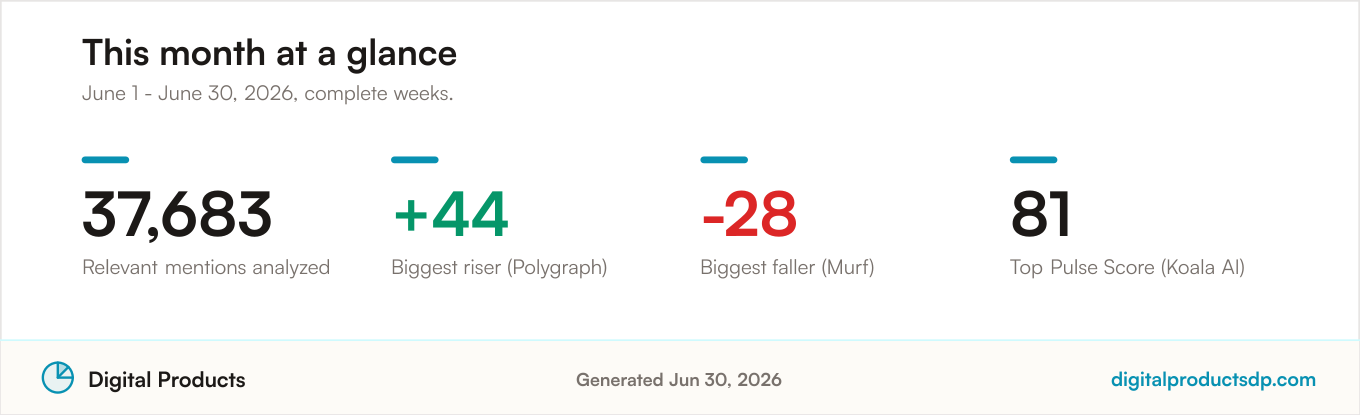
Across the period running from June 1, 2026 through June 30, 2026, we analyzed 37,683 relevant mentions. Of the 2,235 products tracked, 228 cleared the threshold of at least 10 relevant mentions to be eligible for rankings. The sections below read the leaderboard, the category averages, the biggest movers, and the praise and complaint themes that shaped the conversation, always tied to the numbers on record.
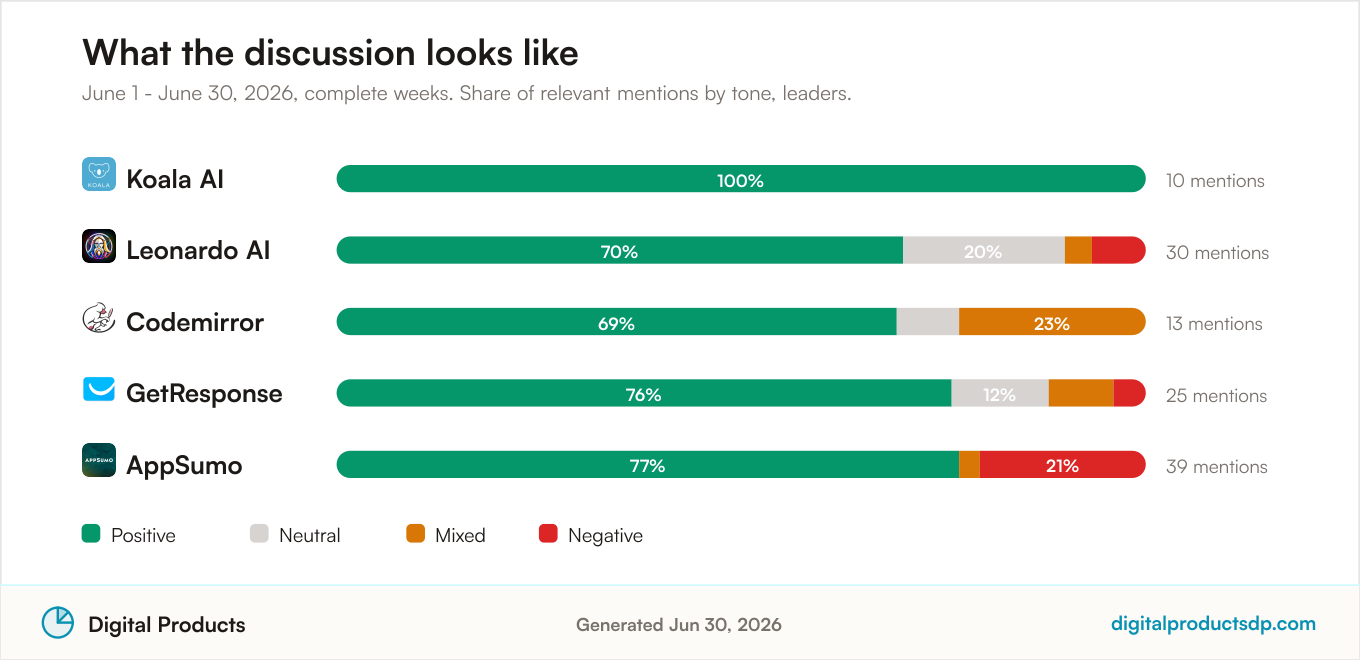
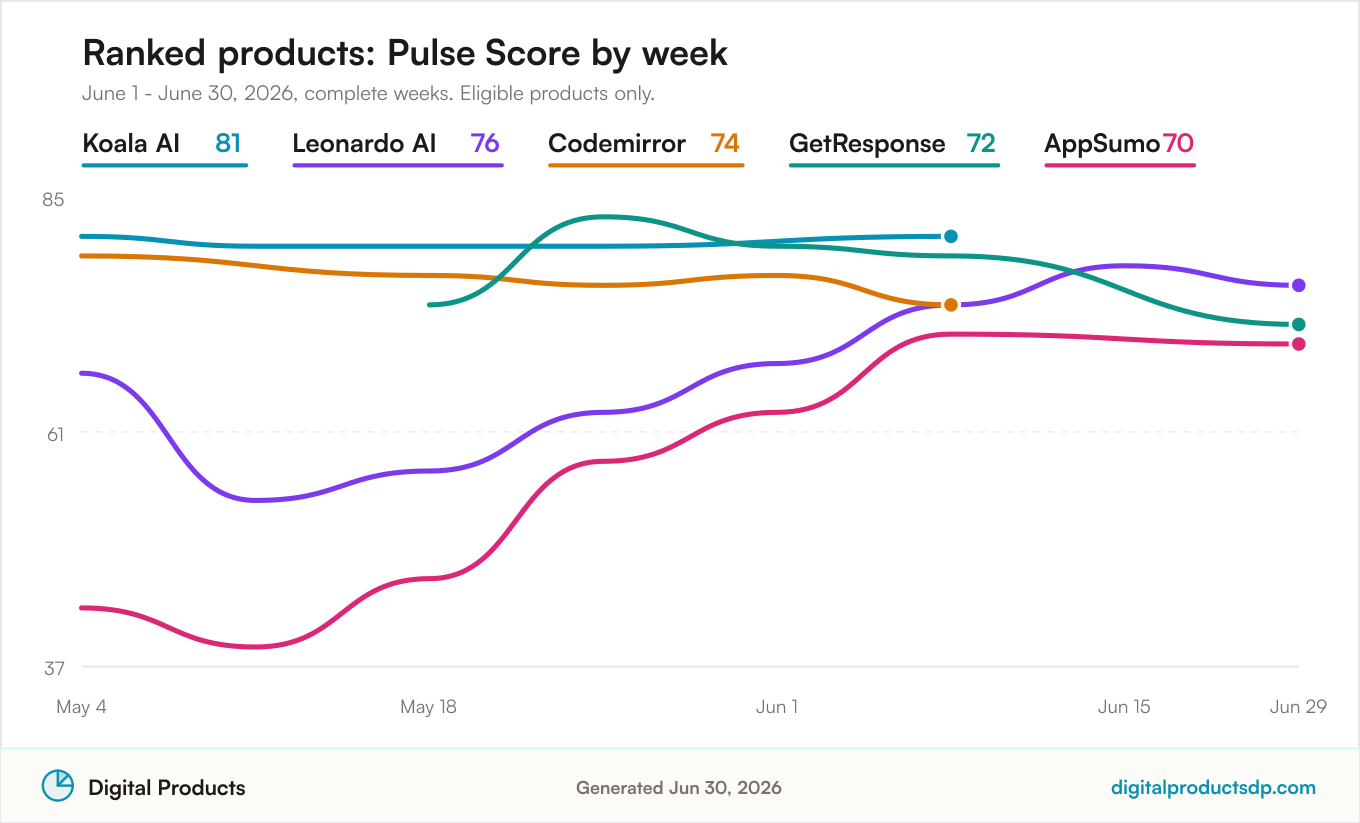
Koala AI, an AI writing tool, held the highest latest-week Pulse Score at 81, based on 10 mentions over the period. It is followed by Leonardo AI, an AI image tool, at 76 based on 30 mentions, and Codemirror, a coding tool, at 74 based on 13 mentions. GetResponse, a marketing platform, sits at 72 based on 25 mentions, and AppSumo, a business deals marketplace, rounds out the top five at 70 based on 39 mentions.
A point worth flagging is how thin some of these leading samples are. Koala AI's leading score rests on just 10 mentions, while AppSumo's 70 is supported by the largest sample among the five at 39 mentions. Higher scores built on small mention counts should be read as narrow, favorable pockets of discussion rather than broad consensus. The leaderboard captures where public chatter leaned most positive this period, not which products were talked about most.
Category View
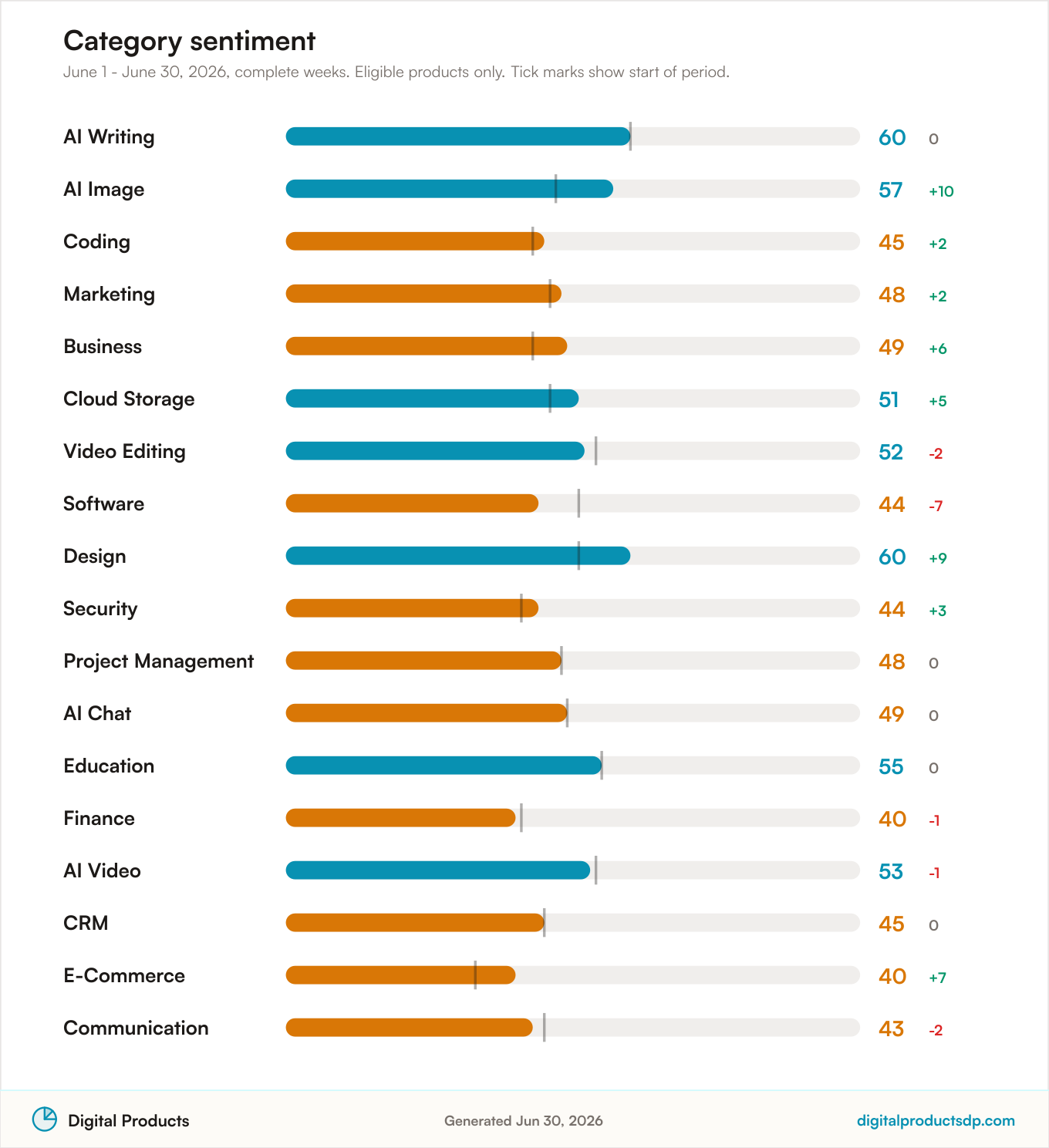
At the category level, design moved up the most among tracked groups, from an average of 51 to 60, and business climbed from 43 to 49. AI image rose from 47 to 57 and cloud-storage edged up from 46 to 51, while e-commerce lifted off a low base from 33 to 40. Movement in the other direction was more muted but present: software slid from 51 to 44, video-editing eased from 54 to 52, and finance dipped from 41 to 40. Several categories were essentially flat, including ai-writing at 60 to 60, crm at 45 to 45, ai-chat at 49 to 49, project-management at 48 to 48, and education at 55 to 55. The overall picture is one of gradual upward drift in a few consumer-facing and creative categories against a softer read for general software.
Biggest Movers
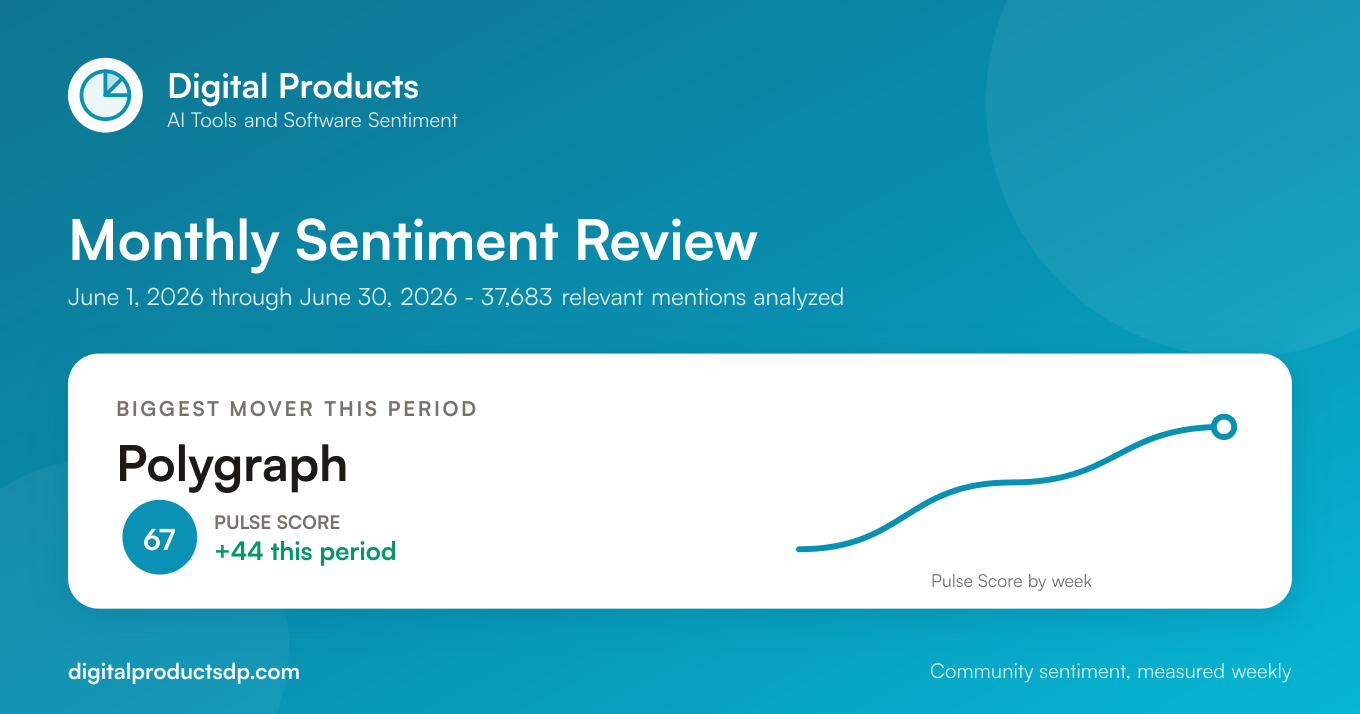
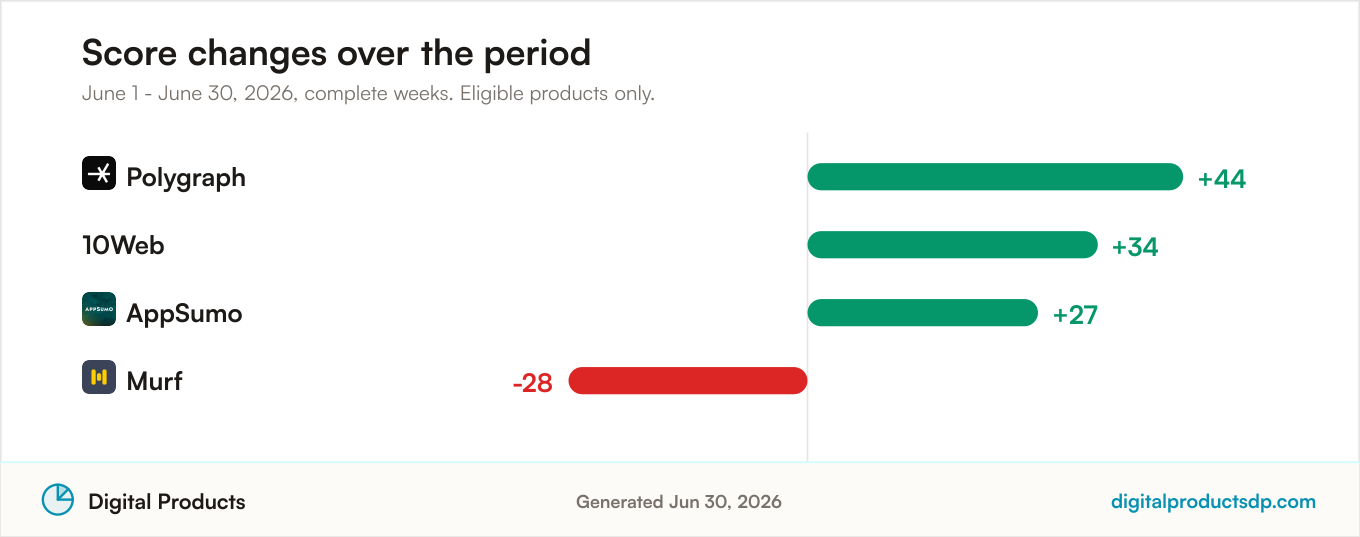
Polygraph (up 23 to 67, based on 21 mentions). Polygraph posted the largest gain of the period, climbing from 23 to 67. Its latest-week themes lean heavily positive, led by Strong features with 12 mentions, New releases with 11, and Good integrations with 9. On the other side, discussion still carried Bugs at 4 mentions, Missing features at 4, and Feature requests at 3, suggesting the positive momentum sits alongside an active list of asks rather than a fully settled experience.
10Web (up 15 to 49, based on 75 mentions). 10Web rose from 15 to 49 on the strength of a larger sample than most movers. Its praise themes were evenly split across AI quality, Strong features, and Compared to rivals, each at 6 mentions. However, its complaint side was the heavier one this period, with Compared to rivals at 9 mentions, Missing features at 7, and Learning curve at 5. The rise reflects recovery from a very low starting point rather than a clean sweep of positive sentiment.
AppSumo (up 43 to 70, based on 39 mentions). AppSumo climbed from 43 to 70 and also earned a top-five leaderboard spot. Praise centered on Strong features at 22 mentions and Fair pricing at 13, with Compared to rivals at 3. Complaints were light, limited to Pricing too high at 1 mention and Compared to rivals at 1. The combination of strong feature talk and pricing appreciation lines up with its steady weekly climb.
Murf (down 73 to 45, based on 23 mentions). Murf recorded the steepest decline, falling from 73 to 45. Its latest-week praise was thin, with AI quality, Feels fast, and Strong features each at a single mention. Complaints dominated the conversation, led by Pricing changes at 5 mentions, Compared to rivals at 4, and Missing features at 3. The pricing-change chatter in particular maps closely to the drop in sentiment.
Robinhood (down 65 to 38, based on 19 mentions). Robinhood slid from 65 to 38. Praise was modest, with Strong features and Good integrations each at 4 mentions and New releases at 3. The complaint side outweighed it, led by Bugs at 11 mentions, Reliability at 7, and Lacking integrations at 3. The concentration of bug and reliability mentions is consistent with the sharp weekly downturn late in the period.
Luma AI (down 78 to 54, based on 24 mentions). Luma AI, an AI video tool, fell from 78 to 54. Its praise themes were sparse this period, with New releases at 5 mentions and AI quality and Strong features each at 1. Complaints included Bugs at 3 mentions, Reliability at 2, and Performance at 2. The move reflects a decline from a high starting point rather than an outright collapse in tone.
Spotlight: Koala AI
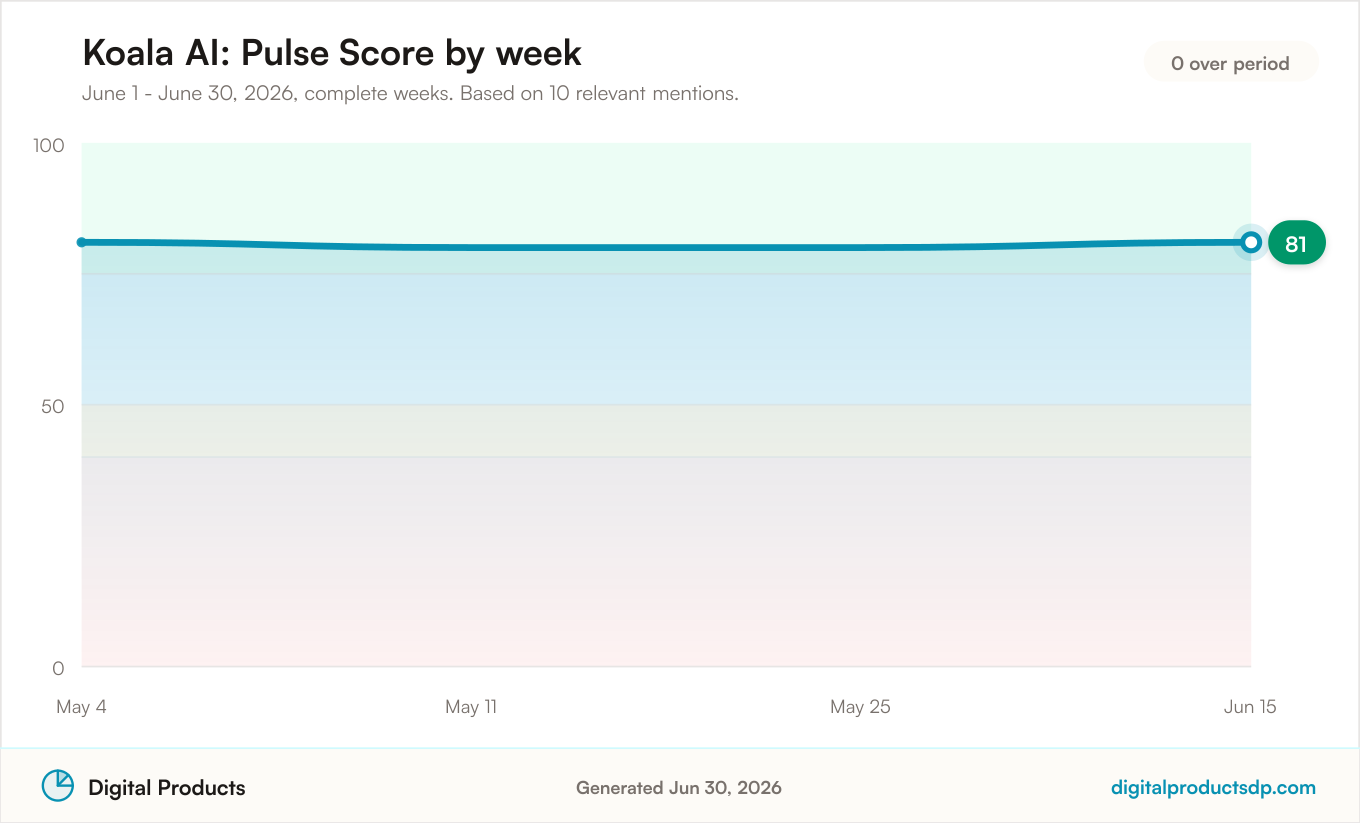
Koala AI led the leaderboard with a latest-week Pulse Score of 81, based on 10 mentions over the period. Its weekly series is notable for its stability at the top of the range: 81 on May 4, 80 on May 11, 80 on May 25, and 81 on June 8. That flat, high line is unusual, and it means the tool's positive tone held steady across the weeks it appeared rather than spiking on a single burst of discussion.
The theme breakdown is entirely favorable in the latest week. Praise was led by Strong features at 9 mentions, Fair pricing at 7, and Compared to rivals at 4, with no complaint themes recorded. In an environment where complaints about bugs and reliability dominated the broader dataset, the complete absence of recorded complaints for Koala AI stands out.
The caveat is sample size. Ten mentions over the period is at the floor of eligibility, so the score reflects a small and consistently positive slice of discussion rather than a large, tested one. That is why Koala AI's leading position should be read as a narrow but genuinely favorable read, one worth watching for whether the tone holds as volume grows.
Themes Driving the Conversation
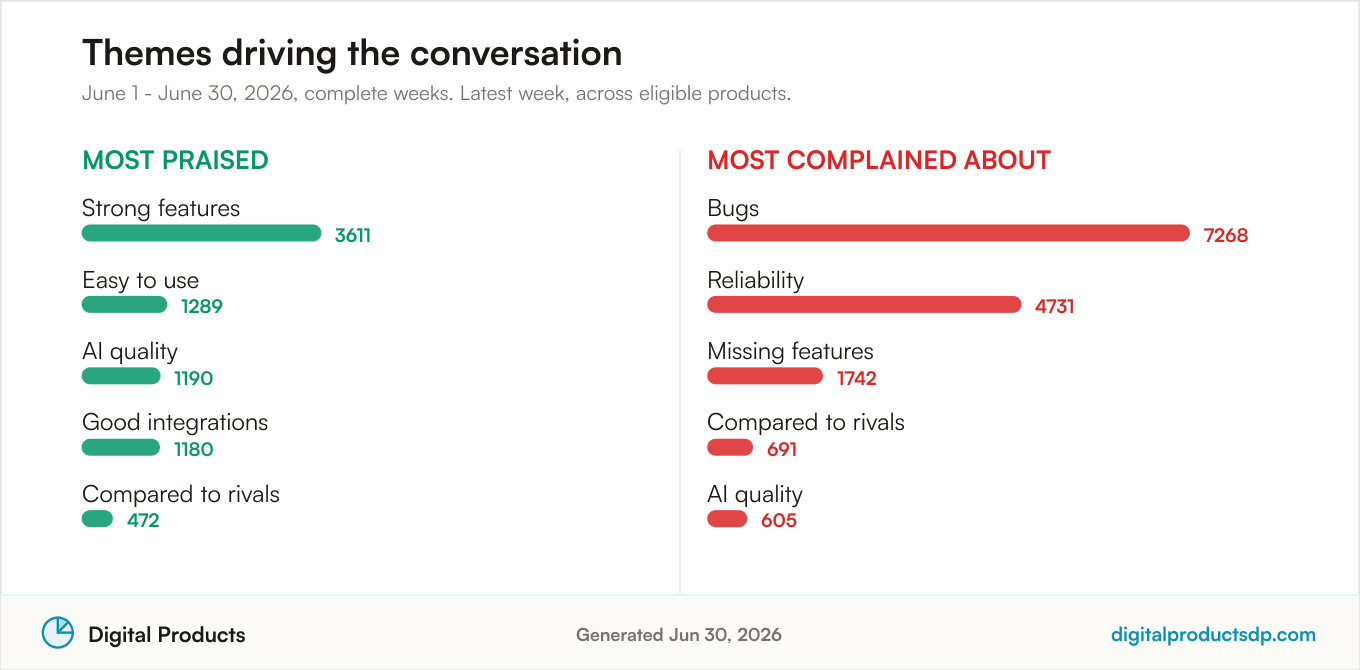
On the praise side, Strong features led with 3,611 mentions, well ahead of Easy to use at 1,289, AI quality at 1,190, and Good integrations at 1,180, with Compared to rivals at 472. Strong features and easy-to-use language show up across the top of the leaderboard and beyond, from AppSumo's 22 Strong features mentions to Canva's 66 Easy to use mentions and Claude Code's 249 Strong features mentions. AI quality praise clusters around the large language and image players, with Gemini at 149 mentions and ChatGPT at 159 in that theme, showing where positive model talk concentrated.
Complaints were both larger in volume and more concentrated. Bugs led every theme in the dataset at 7,268 mentions, followed by Reliability at 4,731, Missing features at 1,742, Compared to rivals at 691, and AI quality at 605. Those two leading complaint themes trace to some of the highest-volume products in the set: ClickHouse carried 441 Bugs mentions and 290 Reliability mentions, Cloudflare 203 and 177, and Stripe 188 and 158. The recurring pattern is that heavily discussed infrastructure and developer tools attract the bulk of bug and reliability chatter, which pulls their category averages down even when feature praise is present.
Watchlist
A large number of tracked products did not clear the 10-mention threshold and are excluded from the rankings this period. This is a matter of discussion volume, not a judgment on quality. Several sat just below the line, including IntelliJ IDEA, SaneBox, and Deel at 9 relevant mentions each, along with Contentful, Livestorm, Contify's peers, and others in the single digits. Just below that, Phabricator, LookAway, CleverCrow, Vanta, Elric-adjacent tools, Vultr, Elastic, WATI, Airwallex, Microsoft Teams, ServiceNow, and Deel-adjacent business tools registered around 8 mentions.
Others surfaced only lightly, such as Haystack, Checkly, Tresorit, Forte, AWeber, Spring, Hygraph, New Relic, OpenStack, and Snowplow at 7 mentions apiece, and Logic Pro, GarageBand, Final Cut Pro, Impact, and Ribbon at 6. A long tail registered zero relevant mentions this period, including many CRM, coding, and communication products. When a product carries too few mentions, its score can swing on a handful of posts, which is exactly the instability the threshold is designed to avoid. We will revisit these as volume builds.
What To Watch Next Month
First, watch whether Koala AI's steady top score holds as mention volume changes. Its 81 rests on only 10 mentions with no recorded complaints, so any rise in discussion volume will test whether that favorable tone is durable or simply a small-sample effect.
Second, watch the recent risers for follow-through. Polygraph jumped to 67 but still carried Bugs and Missing features at 4 mentions each, and 10Web reached 49 while its complaint themes outweighed its praise. Whether those complaint threads shrink or grow will shape whether the gains stick.
Third, watch the categories that moved in opposite directions. Design climbed from 51 to 60 and business rose from 43 to 49, while software eased from 51 to 44. Given how strongly Bugs at 7,268 mentions and Reliability at 4,731 mentions dominated the complaint mix, the question is whether those persistent themes keep weighing on the more infrastructure-heavy categories.
Frequently Asked Questions
Which tool had the highest Pulse Score this period?
Koala AI, an AI writing tool, had the highest latest-week Pulse Score at 81, based on 10 mentions over the period.
Which product moved the most this period?
Polygraph was the biggest riser, climbing from 23 to 67, a gain of 44 points based on 21 mentions. Murf was the biggest faller, dropping from 73 to 45, a decline of 28 points based on 23 mentions.
What was the overall mood across categories?
The mood was mixed but leaned gently upward in creative and consumer categories, with design rising from 51 to 60 and business from 43 to 49, while software eased from 51 to 44. Across the dataset, complaint themes led by Bugs at 7,268 mentions outweighed the top praise theme, Strong features, at 3,611 mentions.
How many mentions were analyzed this period?
We analyzed 37,683 relevant mentions across 228 ranked products, out of 2,235 products tracked, for June 1, 2026 through June 30, 2026.
About This Data
Pulse Scores summarize the tone of public online discussion on a 0-100 scale. They reflect community sentiment, not a verdict on a product's quality or a recommendation. We report on complete calendar weeks only, and products with fewer than 10 relevant mentions in the period are excluded from rankings to avoid unstable reads on thin samples.
Public discussion is collected from Hacker News, Stack Exchange, GitHub, Bluesky, the Apple App Store, and YouTube. Automated sentiment analysis can misread sarcasm, jokes, or niche context, mention volumes vary widely between products, and scores can move week to week. Any company that wants to respond to how it is represented here is welcome to reach out. For more on how scores are calculated, see our methodology.